

Five years after its creation, global automaker Stellantis is confronting a reality far different from early investor expectations. Despite its ambitious scale and brand portfolio, the company’s stock performance has struggled to keep pace since the landmark merger that formed the automaker.
Shares traded in the U.S. have fallen by roughly 43% since the company’s formation, while listings in Europe have declined by about 40%. Stellantis was born in January 2021 through a $52 billion merger between Fiat Chrysler and Groupe PSA, creating one of the world’s largest auto manufacturers by volume.
Initially, the market welcomed the deal. After debuting on the New York Stock Exchange in January 2021, the company’s stock spent much of its early life in positive territory, at one point rising more than 70% by early 2024. That momentum reversed sharply following disappointing financial results, driven by aggressive cost controls and heavy spending tied to electric vehicle development.
Those strategies are now being reassessed under new leadership. Antonio Filosa, who took over as chief executive last summer, has begun reshaping the automaker’s priorities after the abrupt departure of Carlos Tavares in late 2024. Tavares, widely credited with orchestrating the merger, exited amid mounting pressure from weakening sales and strained relationships across the business.
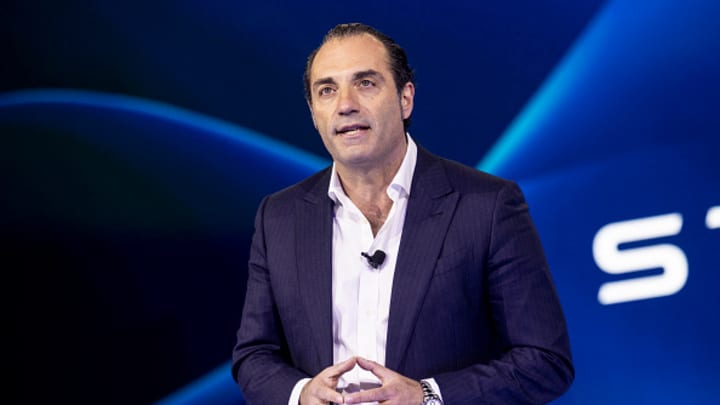
Filosa’s immediate focus is stabilizing and rebuilding Stellantis’ core U.S. brands, particularly Jeep and Ram, both of which have lost market share after years of declining volumes. Speaking at the Detroit Auto Show, Filosa emphasized that execution—not strategy design—will define the year ahead.
He also signaled openness to rethinking the company’s sprawling brand lineup, which includes underperforming Italian marques such as Fiat and Alfa Romeo in the U.S. market. While speculation has circulated about selling or spinning off certain assets, Filosa said his preference is to keep the group intact and focus on operational improvement rather than breakup.
Later this month, Stellantis plans to convene more than 200 senior executives to align on company culture, capital allocation, and preparations for a future capital markets presentation, with an emphasis on execution through 2026.
Investors have been waiting for clarity following Tavares’ exit, which came as the company struggled to meet ambitious profitability targets and growth goals outlined in its long-term strategy. Since Filosa assumed the CEO role in late June, Stellantis shares have edged slightly higher, though they remain well below prior highs.
Internally, the company is moving to repair relationships with dealers, suppliers, unions, and employees—areas that executives have acknowledged suffered under an intense focus on cost cutting. Product plans have also been revised, including pricing adjustments and a reduced emphasis on electrification in favor of near-term market demand.
As Stellantis marks its fifth anniversary, the message from leadership is clear: the next chapter will be defined less by consolidation and more by execution, trust rebuilding, and restoring competitiveness in its most critical markets.
