
Close Menu

    Subscribe to Updates

    Get the latest creative news from FooBar about art, design and business.

    Please enable JavaScript in your browser to complete this form.
    Loading
    What's Hot

    AI Divide Deepens: Why Some See a Game-Changer While Others Remain Unconvinced

    24 February 2026

    James Stephens: Redefining the Architecture of Trust in a Digital Age

    20 January 2026

    Five Years In, Stellantis Resets Course as Shares Lag and New Leadership Pushes for Recovery

    20 January 2026
    Facebook X (Twitter) Instagram
    LinkedIn Instagram X (Twitter) Facebook
    Fortunes Wall
    Subscribe
    • Home
    • Latest

      AI Divide Deepens: Why Some See a Game-Changer While Others Remain Unconvinced

      24 February 2026

      Five Years In, Stellantis Resets Course as Shares Lag and New Leadership Pushes for Recovery

      20 January 2026

      Energy Shares Rally as Markets Weigh Long Road to Reviving Venezuela’s Oil Industry

      6 January 2026

      U.S. Unemployment Rate Climbs to Four-Year High Amid Weakening Job Market

      16 December 2025

      Why Your Next Smartphone Could Cost More Than You Expect

      7 December 2025
    • Magazines
    • News
    • Business Articles
    • Privacy Policy
    • Contact Us
    • About Us
    Fortunes Wall
    • Home
    • Magazines
    • Business Articles
    • News
    • Privacy Policy
    • Contact Us
    • About Us
    Home»Featured»AI Divide Deepens: Why Some See a Game-Changer While Others Remain Unconvinced
    Featured

    AI Divide Deepens: Why Some See a Game-Changer While Others Remain Unconvinced

    Fortunes WallBy Fortunes Wall24 February 2026No Comments4 Mins Read
    Facebook Twitter Pinterest LinkedIn Tumblr WhatsApp VKontakte Email
    AI Divide Deepens: Why Some See a Game-Changer While Others Remain Unconvinced
    Share
    Facebook Twitter LinkedIn Pinterest Email

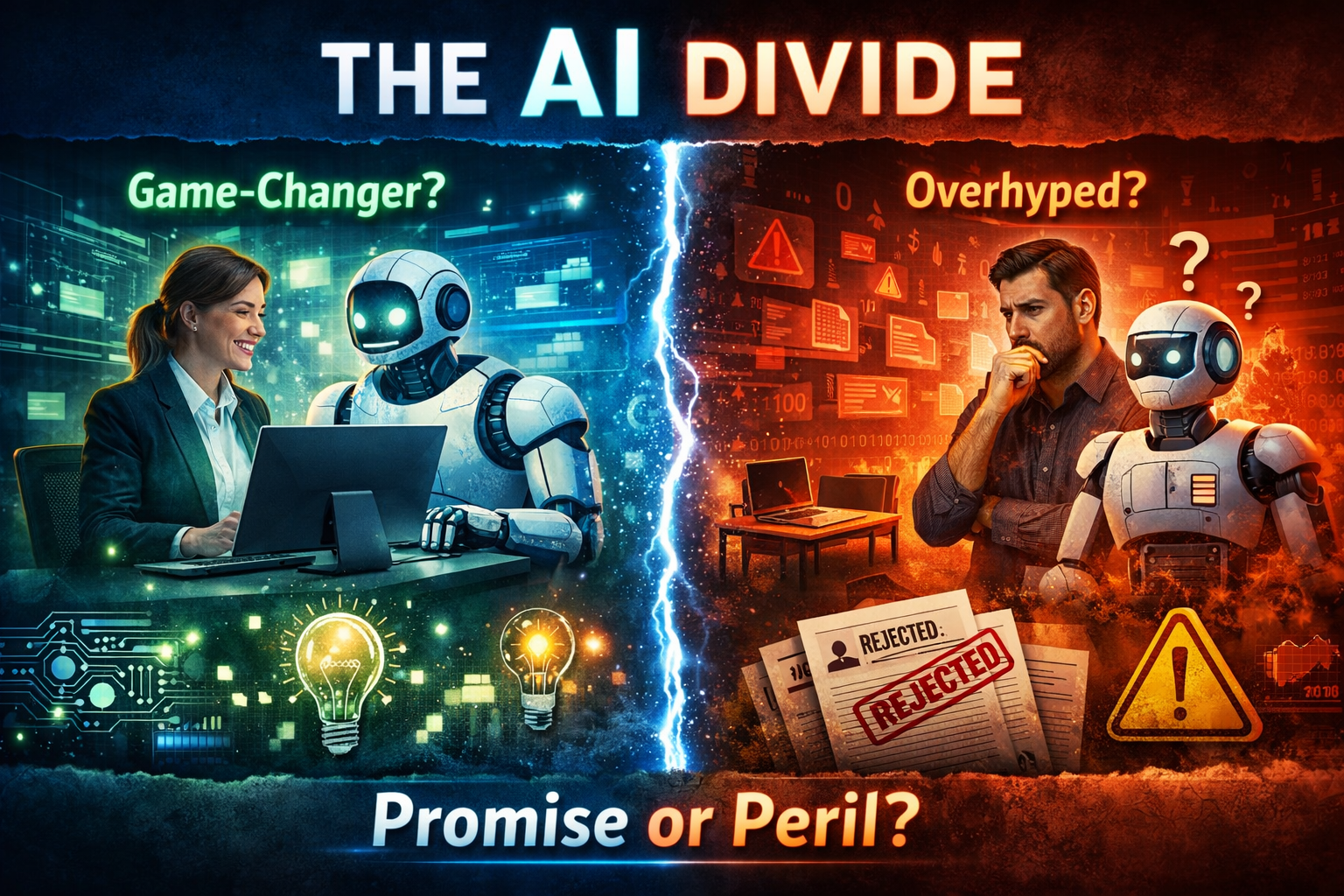
    Artificial intelligence continues to spark sharply different opinions across the tech and business worlds. For some professionals, AI has become an indispensable digital teammate. Others view it as little more than an advanced search tool — or an overhyped trend that has yet to prove its transformative promise.

    The lack of consensus has become increasingly visible as industry leaders promote AI’s potential to reshape the workforce, while critics question whether the technology can deliver on such sweeping claims. At the same time, some researchers and departing executives have raised concerns about safety and long-term risks.

    The debate intensified recently after a widely circulated essay from an AI executive and investor argued that the technology could eventually replace most computer-based jobs. Yet many analysts say the polarized reactions may stem from a simpler reality: people are interacting with very different versions of AI while using the same label to describe them.

    Matt Murphy of Menlo Ventures noted that exposure levels vary widely among users, and adoption patterns are evolving quickly. In other words, experience with AI often shapes perception of its power.


    Free Tools vs. Paid Capabilities

    One major divide lies between free AI tools and subscription-based platforms. Casual users who rely on free versions for everyday tasks — such as trip planning or list-making — typically encounter only the most basic capabilities.

    A Menlo Ventures report from mid-2024 estimated that just 3% of users pay for AI services, though that share is expected to rise. Paid tiers often unlock advanced features, including autonomous “agent” systems that can complete multi-step work rather than simply generate text responses.

    For instance, Claude offers its more advanced Cowork agent only to Pro subscribers, while Codex provides enhanced coding automation in premium plans. These higher-end tools are fueling much of the anxiety about potential job disruption.

    In his viral essay, investor Matt Shumer described directing AI to build an application from scratch — from design flow to code generation — claiming the system produced tens of thousands of lines of functional code. He suggested such capabilities could eventually enable AI systems to iteratively improve themselves.

    However, some AI researchers questioned whether the scenario reflects typical real-world performance, noting that the specific model details and testing conditions were unclear.


    Experts Urge Caution

    Emily DeJeu of Carnegie Mellon University cautioned that judging AI’s full potential based only on free tools can be misleading. Meanwhile, Oren Etzioni, formerly of the Allen Institute for Artificial Intelligence, compared free AI to an eager but inexperienced intern — useful for drafting and summarizing, but not yet reliable for high-stakes professional work.

    Still, the gap between free and paid AI may narrow. Developers are gradually moving stronger capabilities into free tiers. Anthropic, for example, recently introduced a new model designed to bring performance closer to its premium offerings.


    Rising Tensions Around AI and Jobs

    Concerns about automation intensified earlier this year when Anthropic released industry-specific AI tools aimed at fields such as legal and financial analysis. The launch, combined with bold claims from some investors, reignited fears that knowledge work could face widespread disruption similar to what software engineering teams are beginning to experience.

    Yet skepticism remains strong. Research from the Center for AI Safety and Scale AI found that leading models still produce meaningful errors on complex assignments like data visualization and game coding. Another evaluation group reported that developers using AI tools in early-2025 testing actually took longer to complete certain coding tasks.

    James Landay of the Stanford Institute for Human-Centered AI emphasized that AI currently functions best as an accelerator rather than a replacement. Programming, he noted, is highly structured — making it particularly suitable for machine assistance — whereas many other professions involve ambiguity, judgment, and human context that remain difficult for AI to replicate.


    The Bottom Line

    Most experts agree on one point: artificial intelligence will reshape many aspects of work. Where they differ is on speed, scale, and scope.

    For now, AI appears to be neither a universal job killer nor mere hype. Instead, it is a rapidly evolving tool whose real-world impact depends heavily on how — and how deeply — it is used.

    Share. Facebook Twitter Pinterest LinkedIn Tumblr WhatsApp Email
    Previous ArticleJames Stephens: Redefining the Architecture of Trust in a Digital Age
    Fortunes Wall
    • Website

    Related Posts

    Five Years In, Stellantis Resets Course as Shares Lag and New Leadership Pushes for Recovery

    20 January 2026

    Energy Shares Rally as Markets Weigh Long Road to Reviving Venezuela’s Oil Industry

    6 January 2026

    U.S. Unemployment Rate Climbs to Four-Year High Amid Weakening Job Market

    16 December 2025

    Why Your Next Smartphone Could Cost More Than You Expect

    7 December 2025
    Leave A Reply Cancel Reply

    Demo
    Cover Stories

    James Stephens: Redefining the Architecture of Trust in a Digital Age

    20 January 2026

    Dr. John Norris: A Pioneer Leader in Health and Healthcare Innovation and Risk Management

    24 June 2025

    The Transformational Journey of Nilmini Ratwatte: Bridging Education, Equity, and Sustainable Design

    16 April 2025
    • Facebook
    • Twitter
    • Instagram
    • LinkedIn
    Don't Miss

    AI Divide Deepens: Why Some See a Game-Changer While Others Remain Unconvinced

    Artificial intelligence continues to spark sharply different opinions across the tech and business worlds. For…

    James Stephens: Redefining the Architecture of Trust in a Digital Age

    20 January 2026

    Five Years In, Stellantis Resets Course as Shares Lag and New Leadership Pushes for Recovery

    20 January 2026

    Energy Shares Rally as Markets Weigh Long Road to Reviving Venezuela’s Oil Industry

    6 January 2026

    Subscribe to Updates

    Get the latest updates from Fortunes Wall Magazne.

    Please enable JavaScript in your browser to complete this form.
    Loading
    About Us
    About Us

    Welcome to Fortunes Wall Magazine, your go-to source for insights and expertise from top business leaders, CEOs, and entrepreneurs. We deliver the latest news and analysis on contemporary business trends, catering to a global readership passionate about the evolving business landscape. Join us as we explore innovative ideas and success stories from around the world.

    Email Us: info@fortuneswall.com

    Facebook X (Twitter) Instagram LinkedIn
    © 2026 Fortunes Wall Media Tech Fortunes Wall Magazine.
    • Home
    • Magazines
    • Business Articles
    • News
    • Privacy Policy
    • Contact Us
    • About Us

    Type above and press Enter to search. Press Esc to cancel.

    Sign In or Register

    Welcome Back!

    Login to your account below.

    Lost password?