

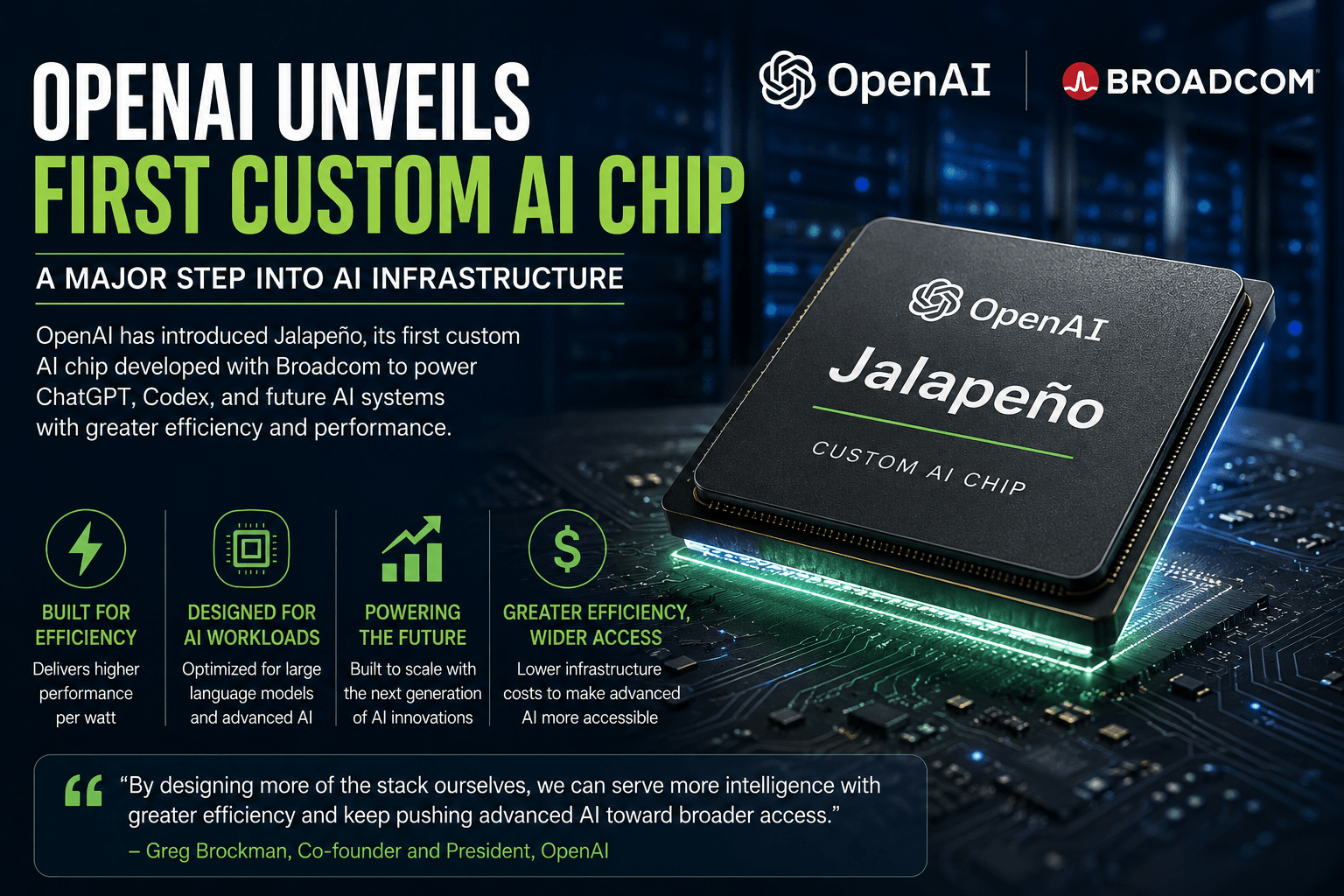
OpenAI has introduced its first proprietary artificial intelligence processor, marking a significant step beyond AI software and into the rapidly expanding world of computing infrastructure.
Named Jalapeño, the new chip was developed in partnership with Broadcom and is designed specifically to support OpenAI’s growing portfolio of AI services, including ChatGPT and its coding assistant, Codex. The company says the processor has been engineered to efficiently manage the demanding workloads required by today’s advanced AI models while preparing for future generations of artificial intelligence.
According to OpenAI, early testing indicates that Jalapeño delivers substantially improved energy efficiency compared with many existing AI processors. Higher performance per watt could help reduce the cost of operating large-scale AI systems while improving overall computing capacity.
The chip represents the first public result of OpenAI’s long-term collaboration with Broadcom, announced previously to build custom hardware capable of supporting massive AI computing infrastructure.
A Strategic Shift Toward AI Infrastructure
Developing proprietary chips has become a growing priority among major technology companies seeking greater control over AI performance and infrastructure. Rather than relying entirely on third-party hardware, organizations are increasingly designing processors optimized specifically for large language models and generative AI applications.
Unlike conventional processors built for a wide variety of computing tasks, Jalapeño has been tailored specifically for artificial intelligence workloads. This specialized approach is expected to improve processing efficiency while reducing dependence on external hardware suppliers.
The move also reflects broader industry efforts to diversify the AI hardware ecosystem as demand for advanced computing continues to accelerate.
Supporting Future AI Growth
OpenAI’s latest announcement comes as demand for AI computing resources reaches unprecedented levels. As AI systems evolve beyond conversational chatbots into autonomous agents capable of handling continuous and complex tasks, the need for more powerful and energy-efficient infrastructure has become increasingly important.
Building custom hardware could allow OpenAI to scale its services more effectively while lowering operational costs associated with training and running increasingly sophisticated AI models.
Expanding Beyond Software
The launch of Jalapeño signals OpenAI’s ambition to become a more significant player in the AI infrastructure market, complementing its leadership in generative AI software.
Industry analysts believe that owning more of the technology stack—from hardware to AI models—can improve performance, increase operational flexibility, and strengthen long-term competitiveness in an increasingly crowded AI marketplace.
Making AI More Accessible
OpenAI says improved efficiency from its custom chip will ultimately benefit users by lowering the cost of delivering AI services. Reduced infrastructure expenses could help make advanced AI tools more widely available across businesses, developers, and consumers.
As investment in artificial intelligence continues to accelerate worldwide, OpenAI’s move into custom silicon highlights an emerging trend: the future of AI will be driven not only by smarter models but also by the specialized hardware that powers them.
