

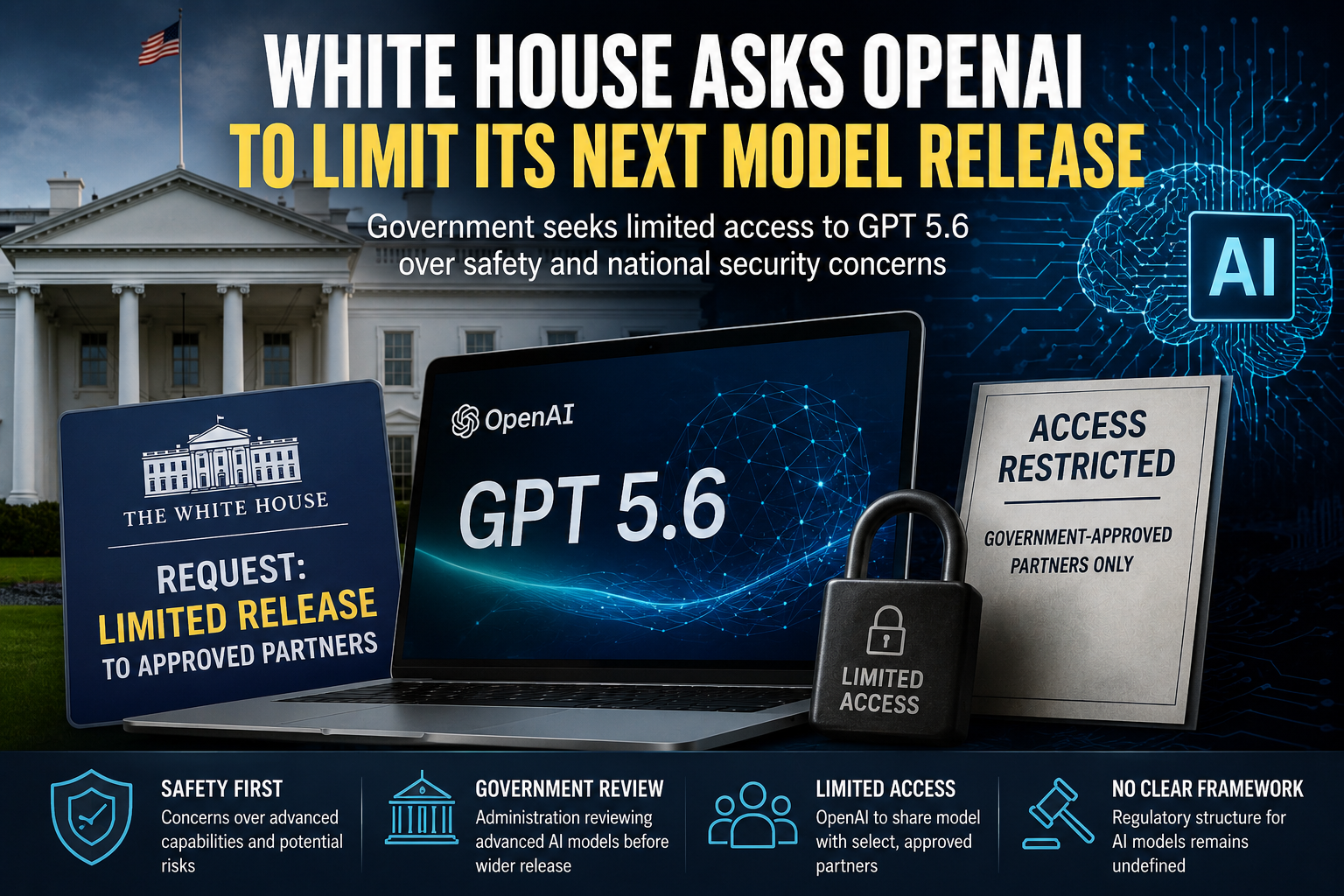
The U.S. government has reportedly asked OpenAI to restrict the initial release of its upcoming AI model, highlighting growing concerns in Washington over the rapid advancement of artificial intelligence and the absence of a clear regulatory framework.
According to reports, the administration requested that access to the next-generation model be limited to a select group of government-approved partners during its early launch phase. The move comes as policymakers increasingly scrutinize powerful AI systems that could have far-reaching implications for cybersecurity, national security, and critical infrastructure.
The request follows recent actions involving Anthropic, whose advanced AI models faced export restrictions due to concerns about their potential capabilities and associated risks. Industry observers say the latest developments demonstrate how governments are becoming more proactive in assessing emerging AI technologies before they are widely deployed.
Sources familiar with the matter indicate that officials view OpenAI’s upcoming model as being among the most advanced systems currently under development. In response, OpenAI has reportedly agreed to a controlled rollout while broader discussions on AI governance continue.
The company is said to have informed employees that the current arrangement is temporary and not intended to become a long-term framework for future product releases. Instead, executives are expected to continue working with government agencies and industry partners to establish more consistent guidelines for the deployment of advanced AI systems.
A White House official said the administration remains engaged with leading AI developers to explore shared approaches to managing the challenges created by increasingly capable technologies.
The issue also underscores a broader challenge facing the AI industry: the lack of a unified regulatory structure in the United States. Earlier this month, President Donald Trump signed an executive order encouraging companies developing advanced AI systems to voluntarily submit models for government review prior to release. However, the mechanisms for implementing that process have yet to be fully defined.
The absence of clear oversight has created uncertainty among technology companies regarding which government agencies hold responsibility for regulating advanced AI. Some decisions have originated from the White House, while others have come through agencies such as the United States Department of Commerce, contributing to concerns about a fragmented regulatory environment.
AI policy experts generally agree that government involvement is necessary, particularly when emerging technologies could affect national security or public safety. However, many also argue that future regulations should be transparent, predictable, and applied consistently to avoid slowing innovation or creating uncertainty for the industry.
As artificial intelligence capabilities continue to accelerate, the debate over how to balance innovation with safety is becoming one of the most important policy questions facing governments and technology companies worldwide.
